The missing link in Bangladesh’s innovation economy
Why translating promising research into investable companies requires its own institutions, capabilities, and disciplined decisions.
Read articleWriting & publications
Essays, published perspectives, and scientific papers on the decisions that shape companies, medicines, and institutions.
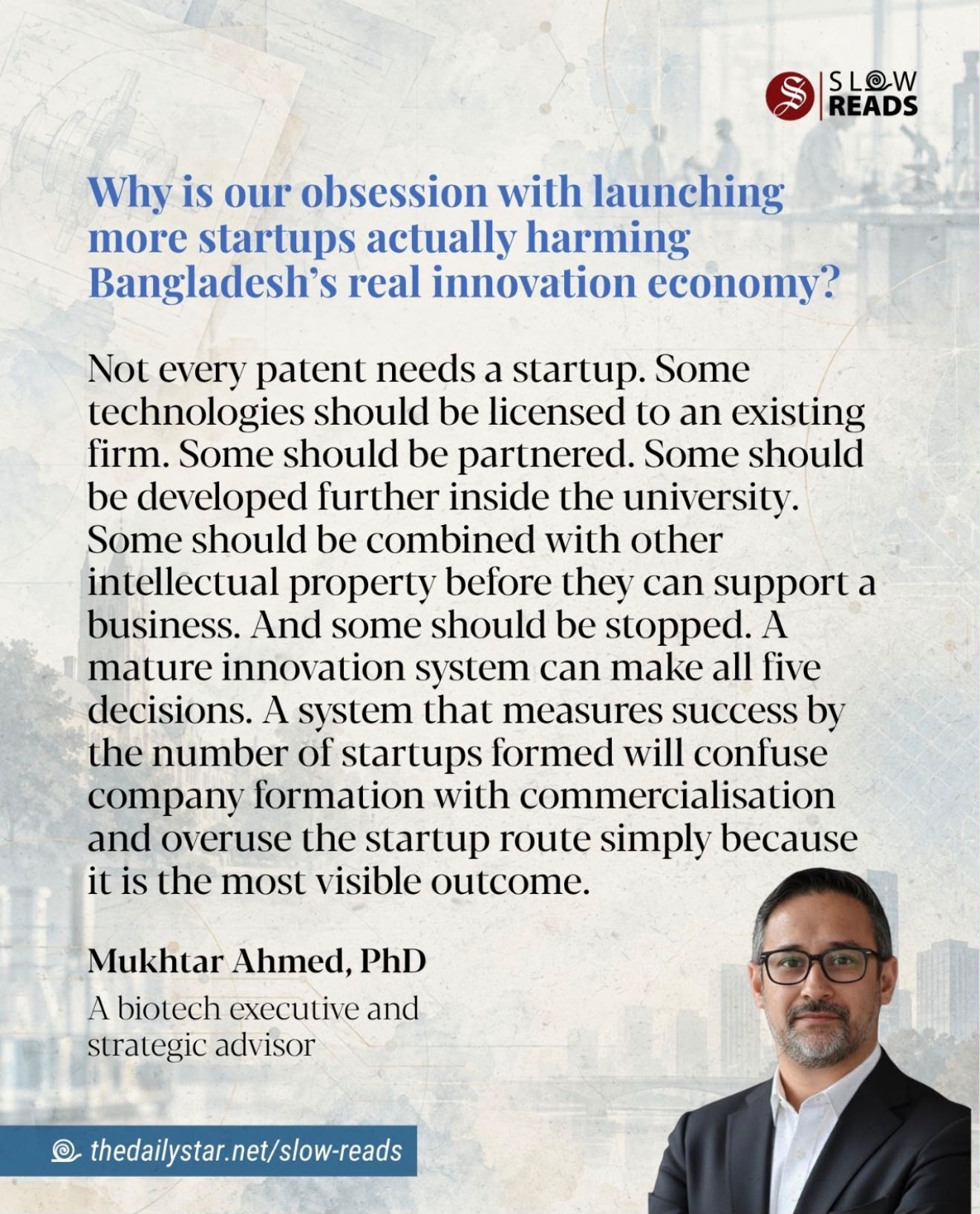
Featured in The Daily Star · Slow Reads
How should promising research become a business? This essay examines the decisions between discovery and commercialisation: licensing, partnerships, further development, company formation, and knowing when to stop.
Read the essay28 works
Why translating promising research into investable companies requires its own institutions, capabilities, and disciplined decisions.
Read articleCapital allocation should preserve the ability to act on new evidence. A practical examination of commitments, uncertainty, and the options that remain after an experiment.
Read articleThe capabilities that supported manufacturing growth must be complemented by institutions that can fund uncertain outcomes, commercialize knowledge, and reward learning.
Read articleAs therapies become more precise, broad disease definitions can limit development. Patient selection, biomarkers, and biological context belong at the beginning of the program.
Read articleAI can expand the set of credible options faster than an organization can act on them. The scarce resources become judgment, attention, and the capacity to commit.
Read articleAn exploration of the compass, questions, and difficult choices that shape strategy before execution begins.
Read articleA perspective on AI in biopharma and the quality of portfolio decisions.
Read articleVenture capital, corporate governance, and the decisions that shape young companies.
Read articleHow organizations make commitments when the probabilities cannot be known in advance.
Read articleWhere AI is strongest today—and where the next bottlenecks in drug development are emerging.
Read articleWhy storing evidence is not enough: organizations also need to preserve the assumptions, disagreements, and judgment behind decisions.
Read articlePart of Biopharma’s 2025 Reset: market signals, changing investor expectations, and the return of strategic discipline.
Read articlePart of Biopharma’s 2025 Reset: how capital, consolidation, and therapeutic focus are reshaping the biotech landscape.
Read articlePart of Human-Relevant Biology as Biotech Strategy: new approach methodologies and their implications for translational risk.
Read articleWhy platforms grounded in human biology may become stronger competitive moats.
Read articleThe economic burden of failed translation and the role of human-relevant models in development strategy.
Read articleWhy drug development’s cost problem cannot be solved by science alone, and why financing models, portfolio discipline, and capital allocation matter.
Read articleHow pharmaceutical companies balance therapeutic impact, commercial sustainability, and public trust.
Read articleFunctional proteomics as a bridge between molecular signals and clinical confidence in rare disease diagnosis.
Read articleA strategic readout of clearer biology, evidence readiness, rare disease momentum, small-molecule resilience, and disciplined development strategy.
Read articleHow iPSC-derived models, microphysiological systems, and computational tools may improve prediction of human drug safety and efficacy—and the remaining challenges of scalability, standardization, reproducibility, and genetic diversity.
Read paperA perspective on the emerging role of human cell models, organoids, microphysiological systems, AI, and computational biology in making preclinical development more clinically predictive.
Read paperPatient genetics and cellular studies connect EXOC2 dysfunction, impaired exocytosis, and disrupted cilia localization to severe neurodevelopmental disease.
Read paperCRISPR/Cas9, high-speed TIRF microscopy, proteomics, and single-molecule imaging reveal how the mammalian exocyst assembles and functions as a dynamic two-part complex.
Read paperHow Par3 recruits the exocyst near tight junctions, enabling basolateral protein delivery, maintaining PI3K–Akt survival signaling, and preventing apoptosis.
Read paperA review of mechanisms that maintain epithelial integrity, architecture, and function, including mechanical sensing, YAP/TAZ signaling, cell extrusion, and cell competition.
Read paperHow KIF14 tethers Radil to microtubules to regulate integrin activation and cell adhesion, and the role of Radil in migration, invasion, and metastasis.
Read paperA signaling mechanism connecting GPCR activation with cell–matrix adhesion through Gβγ, Rap1a, and Radil.
Read paperNo works match that search. Try a different title or subject.